
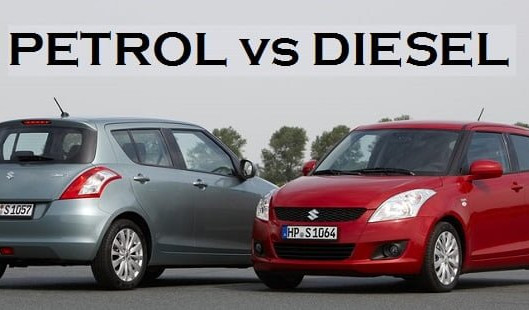
Getting a brand-new car gives you the energy that you might not get to feel otherwise. However, it would be best to consider a few things before signing that cheque.
Performance, mileage, resale value is all-important to look at before deciding on your preferred vehicle.
However, deciding on Petrol or diesel can be a major hurdle in deciding the best ride for you. There are quite a number of similarities and differences between a petrol car and a diesel car. Before deciding the one for you, read through this article to make an informed decision.
Mentioned down below is the comparison between some major characteristics of a petrol car and a diesel car. I hope this helps you end the debate.
Petrol Car vs. Diesel Price: Purchase Price
Generally, Petrol cars tend to be cheaper than diesel variants. A petrol engine needs to maintain a lower compression ratio and handle lesser vibration than the diesel engine.
So, constructing a petrol engine is less costly and is less rugged than a general diesel engine. Not to mention that diesel engine requires extra hardware during the manufacturing process but are more powerful than a petrol engine.
For cars that cost around 30 lakhs, if they contain a petrol combustion engine, they would generally be 2 to 4 lakhs cheaper than those with a diesel combustion engine.
The lower initial cost of a petrol car might have a huge significance on the buyer's preference and the overall economics of the cost of the vehicle.
Petrol Car vs. Diesel Price: Performance and Smoothness
Diesel cars are more powerful than Petrol cars. Due to this, diesel cars have higher torque than a similar petrol ones and provide a smoother driving experience.
At the same time, diesel-driven cars do have a harsh, noisier engine that outputs more vibrations than its counterpart. This disturbance can be a big concern for individuals who prefer a silent vehicle.
The compression ratio in petrol engines ranges from 10:1 to 14:1. Similarly, the diesel engine is constructed in such a way that makes the engine's compression ratio from 14:1 to 22:1. Due to this, the power developed within petrol engines is lower than a diesel engine.
Petrol Car vs. Diesel Price: Maintenance Cost
The minor consumables used in diesel engines, such as engine oil and other spare parts, are more expensive. At the same time, diesel engine contains special fitted filters, which helps in pollution prevention.
These diesel particulate filters (DPF) can clog if you do not drive the car regularly. It would be costly to replace or fix the filter if this happens. So, if you do not intend to use diesel base cars regularly, it might not be the one for you.
However, the average resale value of a used diesel-based engine is higher than a similar petrol-based engine. In general, it would cost more to maintain a diesel car than a Petrol car.
Petrol Car vs. Diesel Price: Engine Life
Due to the properties of diesel, the wear and tear on diesel engines tend to be lesser than what Petrol does to the engine components.
This wear and tear causes diesel engines to have a longer lifespan than petrol engines. As a result of diesel engines' longer lifespan, they have a better resale value than petrol-powered engines.
Petrol Car vs. Diesel Price: Mileage
Compared to Petrol engines, diesel engines tend to run more miles per liter. So, in general, a diesel engine offers better mileage than a petrol engine. Mileage is one of the major factors that persuade a majority of the customers to go for diesel cars.
As mentioned previously, the diesel engine has a higher compression rate because it does not need a spark plug. As a result, a diesel engine utilizes more fuel than a petrol engine.
The little savings can accumulate to large savings that cover the extra amount paid while purchasing the car. Afterward, you can use the savings for other maintenance in the future.
Petrol Car vs. Diesel Price: Emissions
In general, the fuel economy is quite different between diesel and petrol engines. Diesel cars tend to use about 15% to 20% less fuel on average than their counterparts.
This can be noticeable during long road trips. At the same time, due to less fuel consumption, Diesel engines produce less CO2 (Carbon dioxide), which helps fight against climate change and global warming.
But, despite the diesel engine's contribution to carbon emission, it does produce other harmful by-products that might not be environment-friendly.
The nitrogen oxide gas (NO) that these engines produce tends to be more from diesel engines. Nitrogen Oxide contributes greatly to climate change.
Deciding on the Car
As mentioned above, many qualities suggest you choose a diesel car. Similarly, there are equally reliable qualities in Petrol-powered cars. But, the main thing to base your purchase on is your requirements.
Weigh in your requirements on driving regularities, the number of family members, long-term or short-term use, or anything that you prefer, and decide the better option for you.
If you do not fancy both of these options, you can look into getting a hybrid (Petrol and diesel-run) car. These have properties of both these cars as well as similar cons.
If none of these options mentioned above seem suitable for you, there is another environment-friendly option of getting an electric car. They are quite popular and equally efficient. Whatever you decide, think thoroughly before finalizing the decision.
Suggested blogs
View all
Skoda Kushaq Monte Carlo in Nepal: The Epitome of Style and Performance
Jan 21, 2025
Isuzu V-Cross in Nepal: A Perfect Blend of Power and Versatility
Jan 20, 2025

Nissan Magnite in Nepal: A Comprehensive Overview of the Compact SUV Revolution
Jan 19, 2025

Proton X50 in Nepal: A Comprehensive Guide
Jan 19, 2025