
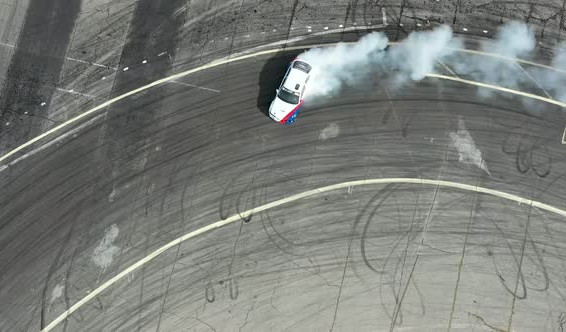
Over time, drifting has fascinated motorsport in the global context with a massive range fanbase. Well, it is known as the fastest-growing car driving technique. Yes, this technique never gets old, and everyone keeps returning for more of it.
Thanks to its elegance and heart-throbbing experience, we get every moment to savor from. Hence, it is fair to say that drifting is an art; when a professional does it, it is indeed full of appreciation.
As astounding as it sounds, how do you think drifting is done? It’s all about physics and a balance between car, driver, and road. In simple words, drifting is done by the driver when they purposely oversteer and cause the rear tires to lose grip on the road.
The Science Of Drifting
We have always searched for thrills and adventure. Not to mention, drifting is our way of squeezing thrill into driving. For those unknowns, drifting is caused all through tires when it is made to lose traction.
Here, the driver intentionally oversteers which causes the tires to lose traction, which will be hard for the driver to control. However, the driver must maintain control of the car while entering and exiting a turn. In technical terms, drifting occurs when the rear slip angle exceeds the front slip angle.
But moving on, you will meet a dangerous end if you can not maneuver the car while turning. While riding, make sure to rotate the steering wheel in the desired direction, which is when friction acts as an integral force.
Without the integral force of friction, drifting or any of this wouldn’t work as nothing would bind them to the road. While floating, the centripetal force is a significant reason that pulls your car in a circular motion.
How To Drift A Car?
Drifting a car is about not losing complete control of the wheels of your vehicle while you lose traction when you make a turn too fast and cause the rear tires to lose their grip on the road, the tires over-rotate in the direction of the turn.
As a result, your car spins, and to control the over rotation; you have to turn the front tires in the opposite direction of the turn. Altogether, you can balance the traction by balancing the wheel speed.
So, does drifting look easy? Well, it’s easy explaining rather than doing it! If not controlled properly, you will have an uncontrolled spin, leading to terrible accidents.
In addition, the art of drifting to master is to invest yourself in a great deal of practice. This is why trained professionals carry out all drifting events under strictly controlled conditions.
Select a car and practice spot
Drifting is often more accessible with a manual transmission car as they have a clutch pedal and a gear shift rather than automatic cars. This extra control enables you to set the correct speed and angle. As in automated vehicles, you can drift by using handbrakes.
Also, if you are looking forward to practicing drifting, do it away from traffic, busy roads, near buildings, or anywhere else you might hit something.
A car with a rear-wheel drive
Rear-wheel drive cars are controllable with the engine, while the other engine controls the front wheels or all 4 wheels. While drifting, the rear wheel is crucial, and the cars with their presence are much easier to manage.
Apart from the rear-wheel drive, you can also choose a car with four-wheel drive as they have stronger back wheels. However, the vehicles with the front wheel drive are challenging to drift as their front wheels control the car to prevent it from sliding. Hence, the car will not float as needed if you understeer with the front-wheel industry.
Help from worn-out tires
Usually, worn-out tires have less traction, making it easy to slide when you bend. Having these worn-out tires on the rear end is better than the front.
Also, drifting is much easier when the road is damp, so you can always try after a little shower.
Three Drifting Ideas
Follow these three drifting ideas for you to try.
Car Drifting is undoubtedly not an easy task.
The Over Power
- The superior speed of bending while drifting is 30 mi (48 km) per hour and while doing so, put the car into second gear. While doing so, if you go too fast, you will lose control; however, if you go slow, you may not have enough speed to bend.
- As you try to bend, turn the steering wheel in the same direction as the bend. Do spin the wheel gently and without much force. Also, keep the car close to the inside part of the turn and ensure your hands are on the reels.
- Slowly press down on the gas pedal and turn the wheel with force this time. However, if you have a hard time, you can use the handbrake or clutch technique with the power over.
- Now, steer away from the drifting direction and continue pressing on the gas.
- As you are around the bend, move to straighten the car as you let go of the throttle to reduce your speed. Focus on where you would want your vehicle to go.
Handbrake for automatics
- With your car’s speed as you approach the turn, steer the car to the outer edge of the road. After that, drift towards the inner corner. Altogether, you flick the steering wheel in the opposite direction away from the turn.
- Then, pull the handbrake up, which will cause the rear wheels to lose traction. Once the car starts to slide, you have to press the clutch to destabilize the back wheels.
- As you let your car slide, you must step on the accelerator while approaching the middle of the turn.
- As you maintain speed, steer toward the curve once you’re halfway through it.
- Now, press the throttle more and keep it steady while steering to straighten the car.
A clutch kick in manual
- Approach the inside edge of a turn at a moderate speed to steer toward the arch. Then, keep your foot on the gas to continue heading in the direction you want to travel.
- Now, kick the clutch pedal in and out a few times to drift. While you’re working the clutch, keep your other foot firmly placed on the gas.
- Press the clutch again if you feel the car losing power or positioning.
- Lastly, release the clutch and wheel to straighten the car. Here, it would help if you turned the steering wheel in the opposite direction.
Suggested blogs
View all
Skoda Kushaq Monte Carlo in Nepal: The Epitome of Style and Performance
Jan 21, 2025
Isuzu V-Cross in Nepal: A Perfect Blend of Power and Versatility
Jan 20, 2025
Nissan Magnite in Nepal: A Comprehensive Overview of the Compact SUV Revolution
Jan 19, 2025

Proton X50 in Nepal: A Comprehensive Guide
Jan 19, 2025