
Today, when in a hurry or the moment of urgency to reach our particular destination, we always sigh relief with the easy accessibility to the mode of road transportation. It is only during such situations that we take a moment to appreciate the efforts taken to create cars.
But at the same time, the appreciation fills our minds with curiosity about when who, and how the first car was introduced in Nepal. Knowing that millions of vehicles inside Nepal today are providing facilities to millions of people across the country, we do credit Ranas for introducing cars back then.
But what if I say that cars were instead introduced in Nepal for their luxury than to think of an accessible mode of transportation? What if I say the people used to carry cars first before the cars started taking them? Indeed, there are plenty of stories about this topic, and today, we ought to discuss and deploy the details on it.
The First Car In Nepal
As far as our legendary stories go, the first car introduced in Nepal dates back to 1922 and belongs to Britain's Prince Edward (later King Edward VIII). Back then, he used to ride the car across the border of Chitwan, Kasara, to hunt tigers. Yes, it was also a similar timeframe when the Ranas ruling in Nepal got immersed in the idea of having cars.
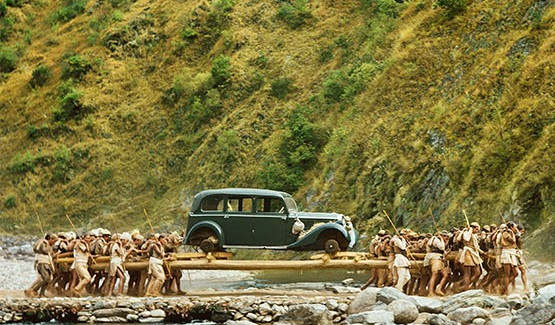
It was an addiction, and the Ranas could not get enough cars, but there were no roads for them to bring these cars inside Kathmandu. But as we say, if there is a will, there is a way; Ranas bought those cars physically through the labor force. Back then, it was Chandra Shamsher who acted as the leading force in this mission, as he initially purchased one for himself.
Hundreds of young, influential youths from villages near Makwanpur were hired to physically carry the cars over the mountains from Bhimphedi to Thankot. During that tenure, Ranas would remove the wheels and seats separated from the car's body and take them separately.
Without road connectivity, the Balami and Tamang porters of the Makwanpur district carried the cars in a bamboo cart. Their usual routes include Chitlang, Kushle Chaur, Markhu Pauwa, Kulekhani, and Phakhel. Initially, the rulers would bring the cars from Kolkata (then Calcutta) and move them to Amlekhgunj.
Later, the potters would carry them, and it would take almost 2-3 days to reach Chunikhel, Thankot. From there on, they would assemble the parts and ride the cars to their respective destinations.
What's more shocking than the physical labor for cars? Well, the potters would often agree to this labor for free and would often take turns to deliver them. At times, if they were to get paid, the minimal wage started from 5 ana to Re.1 and an extra Re. 1 as a commission.
If you look down the history books, you will also see Gehendra Shamsher along the line to import a Ford company vehicle on his own. It is stated that Gehendra was quite fond of cars, and he was the one to install the light in them on his own, as the vehicles that were repurchased in Nepal then had no lights.
Foremost Car Ride In Nepal
Back in the day, no general public was allowed to purchase a car, which was illegal. Even after the first automobile had appeared in Nepal, it was only after 50 years that the general public got no restrictions on car purchases. It has been over a century since the first car was introduced in Nepal.
The manual labor force to carry the imported cars halted only in 1957 when the Tribhuvan Highway was finally opened. According to history, the Rana Prime Minister Shri 3 Bir Shamsher rode the first car entering Nepal during Indra Jatra. Likewise, Veer Shamsher was the first prime minister to ride a car. Slowly and gradually, it became a tradition among the Ranas to buy cars to complement their affluent lifestyle. In simple words, car purchases only aim for a single factor of adding to the wealth of the Shah and Rana families.
Here, when we talk about the history of cars, the thing we cannot miss is the talk about Adolf Hitler and his vehicles. Back in 1939, during the Second World War, he had gifted King Tribhuvan and Juddha Shamsher with two Mercedes Benz that King Tribhuvan drove around the streets of Kathmandu.
Even today, if you are lucky, you might be able to see that same car in expositions and shows. After the death of King Tribhuvan, the car was kept at Thapathali Technical Campus for learning and teaching purposes. Meanwhile, Juddha Shamsher took his automobile to India after abandoning the monarchy.
Regarding the sources, Adolf Hitler presented the gift to entice the Nepali Gurkha Army to join him in the world war. Following it, King Mahendra used to purchase American Chrysler and Mercedes Benz as a part of his royal carriage. After his rule, King Mahendra's car was displayed at the Chhauni National Museum.
Even today, some cars driven by the Rana and Shah families are still a part of history. Well, they are preserved at Nepal Motor Company in Lazimpat, Kathmandu. Furthermore, it has been about four decades since the establishment of the Nepal Automobile Dealer Association (NADA). Likewise, the automobile industry has been taken by storm.
Suggested blogs
View all
Skoda Kushaq Monte Carlo in Nepal: The Epitome of Style and Performance
Jan 21, 2025
Isuzu V-Cross in Nepal: A Perfect Blend of Power and Versatility
Jan 20, 2025
Nissan Magnite in Nepal: A Comprehensive Overview of the Compact SUV Revolution
Jan 19, 2025
Proton X50 in Nepal: A Comprehensive Guide
Jan 19, 2025